jeudi 29 août 2013

One of the top touristy city in the World: Paris, France


Now that we studied Seoul and went a little deeper in the subject of cultural adaptation, it’s time to move on to another global city, the capital of France: Paris.
Before going into details and for you to understand the importance of tourism for this city, we’ll start by giving you some information and numbers about the tourism industry in Paris.

Around the World, Paris is seen as a romantic city

Paris is a highly touristy city. It welcomes around 18 million foreign visitors per year. Among that number, more than 68% of it are English, American, Italian, Spanish, German or Japanese (Mairie de Paris, 2010). British (13.2%), American (11.7%), and Spanish (9.9%) are the first three international clientele of the destination (Do you speak touriste ?, 2013).
The welcome of foreign tourists is considered as a major priority for the city of Paris. A 7 million Euros grant is yearly given to the Paris Tourist Office. Its website is available in 11 different languages, European languages: French, English, Spanish, Italian, German, Portuguese, Dutch, all the languages spoken in the neighboring countries, and Asian languages: Russian, Japanese, Chinese and Korean. This shows the willingness of the city to adapt to its foreign visitors and to inform them the best possible way.
Tourism is the economic backbone of the capital. It generates 300 000 jobs, directly and indirectly. On average, foreign tourists’ expenses in Paris generate around 10 billion euros per year.
Paris is a highly coveted destination for business trips, meetings and events. In 2009, it was the world leading destination for conventions (tied with Vienna) and is still the leader for fairs and exhibitions. 40% of foreign visitors go to Paris for business reasons (Mairie de Paris, 2010).
According to the ranking made by Mastercard of the most visited cities in the World, Paris is ranked 3rd after Bangkok and London (Dufour, A., 2013).

Now that you know a little bit about tourism in Paris and its economic importance for the city, will try to analyze, in following articles, what adjustments the city is carrying out to adapt to foreigners.
As an introduction, we can first mention the project launched recently (June 2013) by the Regional Tourism Committee and Chamber of Commerce of Paris, called “Do you speak touriste ?” (Do you speak touriste ?, 2013).
The objective of this project is to improve the quality of the hospitality and welcome of business owners towards foreign visitors. Indeed, the quality of reception is a key factor of competitiveness for a highly touristy city and Paris reputation abroad, in terms of hospitality, is unsatisfactory. In comparison with others major touristy cities like London, business owners in Paris have a poor mastery of foreign languages, insufficient knowledge about manners and tourists’ expectancies… (Do you speak touriste ?, 2013). This initiative seems to be discerning to me as, going back to the recent questionnaire that we conducted among foreign students (see previous article), we noticed that negative comments about the city of Paris were about the behavior of French people and business owners.
Professionals need to be prepared to meet, at the best, foreign customers’ needs. That is why, for this project, a guide and a website have been created to help Parisian business owners improve their knowledge about foreign visitors and make them learn basics of some foreign languages (Do you speak touriste ?, 2013).
Those tools contain information about:
- Foreigners’ expenses, length of their stay, manners and their expectations according to their nationality;
- The most visited spots in Paris, actuality about local events, leisure and culture;
- Important numbers relative to tourism in the Parisian region and basic notions of foreign languages so that professionals can communicate better with their customers.

Do you speak touriste ? 2013, June. 

The city of Paris seems to have identified a strong issue it has regarding the welcome of foreigner visitors and it is trying to fix it, creating and launching projects like the one described in this article. On following articles, I’ll identify other events or project the city is carrying out to adjust to foreigners. I’ll also write articles about transportation and other facilities composing a global city like we previously did with Seoul.

References

Mairie de Paris. 2010, September 30th. Le tourisme.

Dufour, A., BFM TV. 2013, June. Paris, troisième destination touristique au monde.


L’espace professionnel à la destination Paris, Ile-de-France. 2013, June. Do you speak touriste ?

Do you speak touriste ? 2013. La clientèle internationale.

mardi 27 août 2013

Foreigner's perception of global cities


Along this blog, we already studied how the city of Seoul is accessible to foreigners and we are planning to do the same thing with Canada and the city of Paris.
To go further into the topic of this blog we thought that collecting the impressions and opinions of tourists, expatriates, etc. might add value to the analyses carried out. That is why, we created questionnaires that has been sent to classmates that lived for a short time (around 3 months) in those cities/countries. The respondents of these questionnaires are French, Canadian, Chinese and Korean.
The goal of this survey is to give us an insight about the way some foreigners “felt” living in those cities and their perception about the efforts Seoul, Paris and Canada are making to adapt to them.
Of course, because adaptation to a country/culture is different depending on the culture of origin, we will try to analyze the different answers according to the nationalities of the respondents. For example, it seems normal that westerners will have less trouble adjusting to a western country different from theirs than an Asian person.

A caricature of the World seen by Americans. 2012, February 12th. Retrieved from: My wonderful life. http://alison-staples.blogspot.com/2012/02/how-do-you-see-world.html

To see the different questionnaires, click on the links below:
 - Questionnaire about the city of Seoul: http://fr.surveymonkey.com/s/QS5K8CB
 - Questionnaire about the city of Paris: http://fr.surveymonkey.com/s/Q68NZQ6
 - Questionnaire about Canada: http://fr.surveymonkey.com/s/QZDQBDW

The results

You’ll find below a general overview of the results obtained to this survey. Detailed results will come later on, in following articles.
I decided to split the results into three categories: the answers obtained regarding the place itself and its facilities; the answers got about the local culture and the comparison between the three destinations.
If you have any comment to make, share your opinion or experiences, etc. please feel free to leave a comment on this article or the previous ones.

The city/country and its facilities

The survey was containing several questions about the places themselves and their facilities. One of the questions asked about the troubles experienced by the respondent while doing daily life activities (eating, shopping, visiting, moving).
The activities where most of the respondents encountered trouble while living in those three different places were eating in restaurant and going grocery shopping while very few had to face difficulties using public transportation or visiting touristic spots.
These answers could demonstrate that, because of a high level of tourism in those destinations, public transportation and touristic spots are arranged for foreigners, which would be why almost no trouble was faced for these two activities.

The local culture

As we’ve seen in previous articles, it exists several ways to adapt to a foreign culture such as: assimilation and integration (see the article posted on July, 22nd, “How state policies can influence on the attractiveness of their country abroad?”). To identify which acculturation process the respondents went through, a question in the survey asked which cultural habits they adopted or kept between their birth ones and local ones.
In those three situations, both westerners and easterners kept their cultural habits and adopt some of the local culture. This behavior can, of course, being explained by the fact that respondents only stayed in those places for a short period so they did not want to put aside their own culture. But it has been noticed that none of the respondents kept their cultural habits without adopting some of the local ones which shows the interest, that people living abroad have, in discovering new cultures.

Before going through the acculturation process individuals staying in an unknown country experience a culture shock. This term “culture shock” was first introduced by the anthropologist Kalvero Oberg in 1954. You’ll find below his definition of a culture shock:


Culture shock is precipitated by the anxiety that results from losing all our familiar signs and symbols of social intercourse. These signs or cues include the thousand and one ways in which we orient ourselves to the situations of daily life: when to shake hands, […], how to make purchases, when to accept and when to refuse invitations, when to take statements seriously and when not. Now these cues which may be words, gestures, facial expressions, customs, or norms are acquired by all of us in the course of growing up and are as much a part of our culture as the language we speak or the beliefs we accept. All of us depend for our peace of mind and our efficiency on hundreds of these cues, most of which we do not carry on the level of conscious awareness.”

According to the different answers obtained for this question, we saw that culture shocks have been experienced in France and South Korea, by both westerners and easterners whereas only easterners faced a culture shock in Canada. The common reply regarding the reasons for these culture shocks is language barrier. Indeed, as we saw in previous articles, language is very important has it is the main element of communication. Not speaking the local language makes adaptation harder and slower as the access to the host culture become difficult. These responses reinforce what we said in previous articles about the importance of translations in public places, menus in restaurants, different panels and signs, etc. The multiple translations (to English, Mandarin and Japanese) in Seoul are really appreciated by foreigners. It makes them feel welcome and it prevent them from feeling lost.

Comparison

In order to compare the three destinations, the respondents were asked to grade those places according to the accessibility of the local culture and adaptability to the local life. The degree of simplicity to live as a foreigner in those three destinations has also been asked.
The answers to this part will be given in the future, once articles about the city of Paris and Canada will be published. So watch out this blog if you want to know more about it!

Conclusion

These questionnaires demonstrated, once again, that the first step in adjusting to foreign cultures is to offer various translations of key information. This show how much language is important to integrate or be integrated within a culture.
Culture shocks are experienced by every single individuals living in a foreign country but the intensity of this shock changes from one person to another depending on its birth culture, its host culture, its adaptability to unknown situations, etc. Adjustments carried out by cities and countries to make information, facilities and the local culture accessible to foreigners also play a major role in the intensity of the culture shock experienced.
The answers given to this survey also confirm the fact that is it easier for Westerners to adapt to Western culture than for Easterners and vice versa.

mardi 30 juillet 2013

Business management and city management toward foreign cultures


Throughout this article I will compare businesses adaptation to foreign cultures with global cities adaptation to foreigners.
It is after reading the article “Marketer acculturation: The changer and the changed” written by Lisa Peñaloza & Mary C. Gilly, that I decided to compare the subject studied in this article with this blog theme. To introduce the notion of acculturation, the concept of globalization is first mentioned, followed by a small analysis of the article and how it is related to this blog topic: Should global cities adapt to foreigners and how?

The World is facing an increasing phenomenon since the late 19th century, called “globalization”. Globalization implies the opening of every national economy on a market that became worldwide. It suggests that countries are becoming more and more interconnected and interdependent. This phenomenon is being developed by free trade agreements and economic interdependence, delocalization, the evolution of transportation and communication means, etc.
In view of this orientation, the World’s major cities are welcoming more and more foreigners. Given this, adjustments within metropolises seem to be required to facilitate the integration of immigrants and expatriates as well as to attract tourists. Globalization led to multicultural market juxtapositions that cities have to face adapting to other cultures*.

The notion of acculturation is one of the consequences of globalization. Before going further into the subject, defining this term seems necessary. The authors Redfield, Linton, and Herskovits (1936, p.149) explain the concept of acculturation as the following: “acculturation comprehends those phenomena which result when groups of individuals having different cultures come into continuous first-hand contact with subsequent changes in the original culture patterns of either or both groups”. Acculturation is, of course, accentuated by the market forces of immigration, international trade and tourism.

In the article “Marketer Acculturation: The Changer and the Changed”, the authors studied how retail stores owners, called “marketers” in the text, adapt their products, services and stores to a dominant Latino population in southern states of the United-States. As this blog theme, adaptation to other cultures is the main topic in this paper. Adapt to customers and the changing marketplace is really important in marketing, that is why, in this precise example, marketers “learned and translated language and cultural customs and developed adaptation strategies to work effectively with consumers and other acculturation agents”. “Marketer acculturation is initiated whenever a marketer approaches a culturally distinct group of consumers and consists of the learning and adaptation processes employed in the formulation of appropriate marketing strategies” (Peñaloza, L. & Gilly, M.C., 1999).
In this article are described adaptation strategies for marketers to accommodate their customers. Even though, by going into those stores adapted to their needs, immigrants feel respected and understood, this paper points out that accommodation can have negative effects on immigrants’ integration within the local culture. The term “assimilation”, used in the article, “refers to marketers’ efforts to alter their customers’ behaviors to bring them more into line with the [local] market system.” Which means, in this specific example, that, by providing information on the local market customs, marketers helped Mexican customers adapt to an unknown system.
This is where this article is in accordance with this blog topic. In order to be attractive and to make foreigners feel respected and understood, global cities should adjust their facilities to make the local culture accessible for anybody. As pointed out Raúl Martinez, the manager of a Discount department store interviewed for the purpose of the study, even though some people don’t speak the local language, they want to be treated with respect. He also specified that some foreigners are afraid or feel inferior when they go into malls or stores because nobody speaks their language.
As retailers from this paper, to avoid this feeling, cities can make adjustments in establishments, touristic places, transport, etc. to adapt to foreigners. What is really important to understand is that the purpose of those adjustments is to help foreigners assimilate the local culture but not make them feel like home. In any cases those adjustments should hinder the local culture. Some opponents of globalization often associate this notion with the concept of Americanization which evokes that cultures gradually get closer to the American one causing the extinction of some cultural habits and customs and threating national sovereignty and cultural diversity.
To facilitate foreigners assimilate a new culture, it first needs to be accessible, that is why making information understandable is important. Through this article, the main recurrent element is language. Several retailers interviewed along the study mentioned the fact that they learned their customers’ native language or hire someone who knew it. In order to communicate, receive and share information, the use of a common language is necessary and extremely important.
Let’s take an example quoted in the article, where Lian Ming, a shop owner in the south of the U.S. where customers are mainly Latinos, explains the importance of speaking Spanish to communicate directly with her clients. Language is critical to build cultural rapport as well as strong and closer relationships.
A major city (and what compose it) is a place considered as a cultural agent for locals and foreigners living in it. The purpose of making adjustment to facilitate foreigners’ adaptation is that cities pass their cultural values onto foreigners through making it accessible, helping them assimilate into the local market.
In this blog article, we compare the management of a city with the management of a business. Businesses adapt their products/services to the selected target so it fits customers’ needs. If they want to satisfy their inhabitants and at the same time attract tourists and foreigners, cities have to protect their own local culture but make it accessible and welcoming to foreigners.
This paper explains that in accommodating foreign customers, marketers were changed by them and at the same time customers changed their consumption habits in assimilating the local culture. Thus, marketers and consumers simultaneously were “the changers and the changed”. The similarity with this blog subject is that cities have to change to adjust to foreigners and foreigners have to change to assimilate the local culture. As in the paper, both cities and immigrants are simultaneously “the changer and the changed”. The difference here is that, as explained above, by making those adjustments, cities should not damage the local culture or replace it at some levels.

*Culture: the shared meanings, practices, and symbols that constitute the human world. (Peñaloza, L. & Gilly, M.C., 1999).

References:

Peñaloza, L. & Gilly, M. C. Journal of Marketing, July 1999. Marketer acculturation: The changer and the changed.

Redfield, R., Linton, R., & Herskovits, M. (1936). Memorandum on the study of acculturation. American Anthropologist. 38. p.149-152.

lundi 22 juillet 2013

How state policies can influence on the attractiveness of their country abroad?


In the previous article called “About the theme of this blog…”, the concepts of segregation, integration and assimilation have been mentioned. Those three notions are acculturation orientations which individuals are subject to when living in a foreign country and being confronted to a different culture. 
In the following article we will develop more about acculturation orientations analyzing the two different models: Gordon’s unidimensional assimilation model and Berry’s bidimentional model of acculturation.
Once the different acculturation orientations explained we see how they can be the consequences of states policies and have an influence on the country’s attractiveness for foreigners to live in.
This is where this article is in accordance this blog topic: Should global cities adapt to foreigners? And what are the consequences of these adjustments on the attractiveness of the city for tourists and immigrants?

Anthropologists describe acculturation as “the process of bidirectional change that takes place when two ethnocultural groups come into contact with one another” (Bourhis, Moïse, Perrault, Senécal, 1997).

In opposition to Gordon’s unidimensional assimilation model (Gordon, 1964), Berry (Berry, 1980) developed a bidimentional model of acculturation. The distinction between the two theories is that the unidimensional assimilation model suggests a single directional change process in which immigrants assimilate the local culture at the cost of losing their own whereas the bidimentional models consider that heritage and host culture have to be assessed separately and be presented “as independent dimensions rather than as extreme points of a single bipolar continuum” (Bourhis, Moïse, Perrault, Senécal, 1997).

To illustrate Gordon’s theory, we sketched it as below:


Whereas, Berry’s bidimensional acculturation model is represented as the table below:


According to this model, integration is an acculturation orientation where immigrants both maintain their own cultural identity and adopt the local one. On the opposite, marginalization happens when neither the heritage culture nor the host one is taken on by an individual.
Assimilation is present when the immigrant entirely takes over the local cultural identity, losing its birth one, whereas separation occurs when the individual maintain its cultural identity and do not adopt the host culture.

Bourhis et al. developed Berry’s model into the interactive acculturation model (IAM). The significant difference between the previous two acculturation models is that the IAM involves the reaction of the host population towards immigrants because locals are also changed by the presence of culturally distinctive individuals (Taft, 1953).
That is why a second table is part of this theory, where this time the questions (“Is it considered to be value to maintain cultural identity and characteristics [dimension 1]/to maintain relationship with other groups [dimension 2]?”) about the two dimensions are asked to locals and not immigrants:


According to this model, integration is an orientation that implies that the host community values a stable biculturalism amongst immigrant group. Assimilation suggests that over time, locals will consider immigrants as members of the host community in their own right. The segregation orientation means that the host community does not wish to integrate immigrants or establish cross-cultural contacts. Locals would be in favor of keeping separate the different communities. Exclusionist orientation happens when the host community denies immigrants’ freedom to maintain their own cultural identity or to adopt the local one. It is usually against immigration and would be in favor for it to stop.
The individualist orientation is not in favor of maintaining nor adopting the heritage or host cultural identity since members of this orientation define themselves as individuals rather than as part of a group. To individualists, personal characteristics prevail over cultural identity. According to them, the success of their acculturation won’t be related to those two dimensions.

The next part of the interactive acculturation model suggests that depending on the immigrant and host community acculturation orientations, conflicting situations may happen.

The article Towards an interactive acculturation model: a social psychological approach(Bourhis, Moïse, Perrault, Senécal, 1997) tries to demonstrate the role, institutional policies have in foreigners’ acculturation. This responsibility is very important as it has implications on individuals’ acculturation orientations and therefor on the harmony of the society.
The diagram below retrieved from the article illustrates the relations between state integration and immigration policies, acculturation orientations and relational outcomes within the society:

“State immigration and integration policies as they relate to the acculturation orientations of immigrants’ community members and dominant host majority members” (Bourhis, Moïse, Perrault, Senécal, 1997).

What is most interesting to us, relatively to this blog’s main topic, are the implications of state integration policies on individuals’ acculturation orientations. Those policies “consist of approaches and measure adopted by state agencies to help immigrants integrate within the host society [… and] foster host community acceptance of immigrants” (Bourhis, Moïse, Perrault, Senécal, 1997).

This blog is trying to identify how global cities adapt to foreign cultures and make their environment welcoming in order to attract or retain foreigners. The article analyzed above and below show that institutional policies and accommodations put it place do influence the acculturation of individuals which will have an impact on the attractiveness of some cities for tourists, expatriates and immigrants.

As we can see on the illustration above, state integration policies have been split into 4 categories: pluralism ideology, civic ideology, assimilation ideology, republican ideology and ethnist ideology.
Those 5 ideologies share a fundamental premise: the modern state expects immigrant to adopt public values of the host country (commitment to democratic ideals, adherence to the Civil and Criminal code, adherence to values expressed in Human Rights Charters and Constitution of the state).
The pluralism ideology supports the idea that the state cannot control or rule individuals’ private values (language, cultural activities, religion, freedom of association in politics, economics and leisure). The citizens’ personal freedom is highly respected in a pluralist nation. A state adopting this ideology will provide both financial and social support to minority communities and immigrants.
The distinction between the pluralism ideology and the civic ideology is that the state won’t intervene in financing or promoting private values of specific groups of individuals, even though the collective organization to preserve or promote cultural distinctiveness is allowed and respected.
In opposition to the pluralism and civic ideologies, the assimilation ideology upholds the fact that the state can interfere with some private values of individuals. Immigrants living in nation with assimilation ideology are expected to adopt the cultural values of the dominant community abandoning their own ones. States sometimes limit manifestations of immigrant cultural distinctiveness.
The republican ideology is close to the assimilation ideology. It is in favor of the “universal man” where cultural distinctions have to be eliminated. Ethnolinguistic dissimilarities have to be “leveled-out” for citizens to be treated equally.
The main difference about the ethnist ideology with all the others discussed above is that, usually, it choses who can be part of the dominant community. In some country, origins and “blood” are the main criteria, “only members of selected “racial” groups can gain full legal status as citizens of the state” (Bourhis, Moïse, Perrault, Senécal, 1997).

Pluralism and civic ideologies tend to orientate towards integration and therefor harmony among immigrants and host communities whereas the ethnist ideology would lean towards separation and segregation orientations which could lead to a conflict and problematic situation.
The illustration below summaries how state policies are related cultural issues and the attractiveness of the country for foreigners.


What can be learned from this analysis is that in order to be attractive and retain foreigners in a country a consensual situation has to be reached rather than a problematic one.
Consensus is more likely to occur if integration or assimilation orientations are adopted by both foreigners and locals.
Considering the theories and analysis above, pluralism and civic ideologies adopted by states will tend to move toward consensus and harmony among the community.
Cities managers should take into account the influence state policies have on acculturation orientation of foreigners and locals and their implications on the attractiveness of the country abroad. 


References:

Berry, J. W. 1980. Acculturation as varieties of adaptation.


Bourhis, R. Y., Moïse, L. C., Perrault, S., Senécal, S. 1997. Towards an interactive acculturation model: a social psychological approach.


Gordon, M. M. 1964. Assimilation in American life.

Ngo, V. H. 2008. A critical examination of acculturation theories.

Retrieved from: http://www1.uwindsor.ca/criticalsocialwork/a-critical-examination-of-acculturation-theories


Taft, R. 1953. The shared frame of reference concept applied to the assimilation of immigrants.


mercredi 3 juillet 2013

Seoul's supermakets


After analysing restaurants, public transportation, touristic spots and universities we are going to take a look at supermarkets established in the city of Seoul.
The 4 main supermarkets present in the city are: Lotte Mart, E-Mart, HomePlus and Costco.
Supermarkets mostly affect foreigners living in Seoul for a long period as tourists generally don’t go grocery shopping and go eat in restaurants. Nevertheless, it remains an important place for everyday day life. Besides consumption is considered as a strong cultural element. According to the authors Martyn J. Lee and Grant McCracken: “Culture is recognized as a general influence on consumption; it is constituted and expressed in the consumption of countless products and services.” (Peñaloza, L. & Gilly, M.C., 1999).
After reading the article of Lisa Peñazola and Martin C. Gilly, “Marketer acculturation: the changer and the changed”, I decided that would be considered, for this analysis, the following elements: opening hours, methods of payment, names of the supermarkets, signs and display, sales support service as well as websites and information lines.

Opening hours:
Opening hours are wide, some supermarkets are open 24 hours a day while most of them are open from 10:00 am till midnight. A few of them are closed on Sunday (usually 2 Sundays a month).

Websites & Information lines:
The information lines offered by the four main supermarket chains present in Seoul are all available in English, Chinese and Japanese. (Korea Be Inspired, 2012).
Both E-Mart and Lotte Mart’s websites are also available in those three languages (other than Korean), but HomePlus’ one doesn’t seem to offer that possibility. On its side, Costco’s website is only available in Korean and English.

Names:
As you can see on the logos below, Supermarkets in Korea all possess an English name written with the Roman alphabet. Those names are easy to pronounce for Korean and English speakers.


Signs and display:


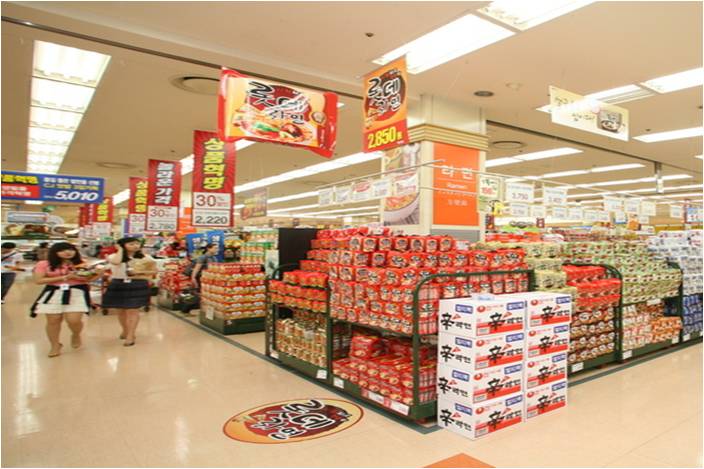
Overhanging shelves full of products, signs informing about promotions and products have a strong presence in supermarkets. In Seoul, most of them are written in Korean but numbers and percentages written using Arabic numerical system can be understood by everyone.
Some basic words such as: open, close, on, off, event, sale, etc. are sometimes used and written in English. I would, however, consider this phenomenon as linked to the fact that some English words are becoming more and more part of the informal language in some countries rather than to the willingness of supermarkets to adapt to foreigners.
The customer service and tax free service desks are usually indicated in English and sometimes in Chinese and Japanese.


Methods of payment:
As in most stores in the World, supermarkets in Seoul accept cash (only Korean Won) and credit cards. Nevertheless, some credit card types such as Visa may not be accepted in every shop.

Of course those supermarkets are part of famous chains that are quite well implemented in Korea. Seoul possesses a few stores and online services whose targets are foreigners. For example, High Street market is a shop located in Itaewon (district of Seoul popular for its high concentration of foreign residents) that offers imported Western goods. Products available are mainly from the US, Canada and the UK as most of their packaging are in English. The staff speaks English and sometimes others languages. The shop owns a website entirely written in English.
In the same thought, the website Fatbag is an Internet superstore for foreigners in Korea. It also sells imported Western products and even IKEA items. The website offers a certain amount of products coming from North American countries, Latin America, Europe, South Africa and Asia; the widest choice of products being those coming from North America. Payment can be made via credit card (Visa, MasterCard, American Express) or Paypal, WireTransfer, etc.
The website is available in English and prices of products can even been shown in dollar (instead of Won).
Those real and online stores are really useful for foreigners that are having trouble getting used to Korean food. Unfortunately, physical stores are spread enough the city for everybody to have one next to home and some people do not feel comfortable shopping online.

As we had noticed through this analysis, supermarkets are making some effort to attract foreigners in their stores thanks to their website, information line and wide opening hours but once in the store foreigners to face Korean signs and products. Indeed for people that can’t read Korean and unfamiliar with Asian products, it takes a little time strolling through shelves recognising and trying to guess what products are.
Of course supermarkets have the same objective than any other business: be profitable. To make money, the number one marketing rule is: identify your customers and adapt your products/services to your target. Supermarkets’ main target being people that live nearby their shop, most of those individuals in the South Korean capital are usually locals; which is why few adaptation to foreigners has been noticed.

References:

Lee, M. J. 1993. Consumer culture reborn: the cultural politics of consumption.

Korea Be Inspired. 2012. Travel highlights.
Retrieved from: http://english.visitkorea.or.kr/enu/SI/SI_EN_3_6.jsp?cid=682553

McCracken, G. 1988. Culture and consumption: new approaches to the symbolic character of consumer goods and activities.

Peñaloza, L. & Gilly, M. C. Journal of Marketing, July 1999. Marketer acculturation: The changer and the changed.