mardi 30 juillet 2013

Business management and city management toward foreign cultures


Throughout this article I will compare businesses adaptation to foreign cultures with global cities adaptation to foreigners.
It is after reading the article “Marketer acculturation: The changer and the changed” written by Lisa Peñaloza & Mary C. Gilly, that I decided to compare the subject studied in this article with this blog theme. To introduce the notion of acculturation, the concept of globalization is first mentioned, followed by a small analysis of the article and how it is related to this blog topic: Should global cities adapt to foreigners and how?

The World is facing an increasing phenomenon since the late 19th century, called “globalization”. Globalization implies the opening of every national economy on a market that became worldwide. It suggests that countries are becoming more and more interconnected and interdependent. This phenomenon is being developed by free trade agreements and economic interdependence, delocalization, the evolution of transportation and communication means, etc.
In view of this orientation, the World’s major cities are welcoming more and more foreigners. Given this, adjustments within metropolises seem to be required to facilitate the integration of immigrants and expatriates as well as to attract tourists. Globalization led to multicultural market juxtapositions that cities have to face adapting to other cultures*.

The notion of acculturation is one of the consequences of globalization. Before going further into the subject, defining this term seems necessary. The authors Redfield, Linton, and Herskovits (1936, p.149) explain the concept of acculturation as the following: “acculturation comprehends those phenomena which result when groups of individuals having different cultures come into continuous first-hand contact with subsequent changes in the original culture patterns of either or both groups”. Acculturation is, of course, accentuated by the market forces of immigration, international trade and tourism.

In the article “Marketer Acculturation: The Changer and the Changed”, the authors studied how retail stores owners, called “marketers” in the text, adapt their products, services and stores to a dominant Latino population in southern states of the United-States. As this blog theme, adaptation to other cultures is the main topic in this paper. Adapt to customers and the changing marketplace is really important in marketing, that is why, in this precise example, marketers “learned and translated language and cultural customs and developed adaptation strategies to work effectively with consumers and other acculturation agents”. “Marketer acculturation is initiated whenever a marketer approaches a culturally distinct group of consumers and consists of the learning and adaptation processes employed in the formulation of appropriate marketing strategies” (Peñaloza, L. & Gilly, M.C., 1999).
In this article are described adaptation strategies for marketers to accommodate their customers. Even though, by going into those stores adapted to their needs, immigrants feel respected and understood, this paper points out that accommodation can have negative effects on immigrants’ integration within the local culture. The term “assimilation”, used in the article, “refers to marketers’ efforts to alter their customers’ behaviors to bring them more into line with the [local] market system.” Which means, in this specific example, that, by providing information on the local market customs, marketers helped Mexican customers adapt to an unknown system.
This is where this article is in accordance with this blog topic. In order to be attractive and to make foreigners feel respected and understood, global cities should adjust their facilities to make the local culture accessible for anybody. As pointed out Raúl Martinez, the manager of a Discount department store interviewed for the purpose of the study, even though some people don’t speak the local language, they want to be treated with respect. He also specified that some foreigners are afraid or feel inferior when they go into malls or stores because nobody speaks their language.
As retailers from this paper, to avoid this feeling, cities can make adjustments in establishments, touristic places, transport, etc. to adapt to foreigners. What is really important to understand is that the purpose of those adjustments is to help foreigners assimilate the local culture but not make them feel like home. In any cases those adjustments should hinder the local culture. Some opponents of globalization often associate this notion with the concept of Americanization which evokes that cultures gradually get closer to the American one causing the extinction of some cultural habits and customs and threating national sovereignty and cultural diversity.
To facilitate foreigners assimilate a new culture, it first needs to be accessible, that is why making information understandable is important. Through this article, the main recurrent element is language. Several retailers interviewed along the study mentioned the fact that they learned their customers’ native language or hire someone who knew it. In order to communicate, receive and share information, the use of a common language is necessary and extremely important.
Let’s take an example quoted in the article, where Lian Ming, a shop owner in the south of the U.S. where customers are mainly Latinos, explains the importance of speaking Spanish to communicate directly with her clients. Language is critical to build cultural rapport as well as strong and closer relationships.
A major city (and what compose it) is a place considered as a cultural agent for locals and foreigners living in it. The purpose of making adjustment to facilitate foreigners’ adaptation is that cities pass their cultural values onto foreigners through making it accessible, helping them assimilate into the local market.
In this blog article, we compare the management of a city with the management of a business. Businesses adapt their products/services to the selected target so it fits customers’ needs. If they want to satisfy their inhabitants and at the same time attract tourists and foreigners, cities have to protect their own local culture but make it accessible and welcoming to foreigners.
This paper explains that in accommodating foreign customers, marketers were changed by them and at the same time customers changed their consumption habits in assimilating the local culture. Thus, marketers and consumers simultaneously were “the changers and the changed”. The similarity with this blog subject is that cities have to change to adjust to foreigners and foreigners have to change to assimilate the local culture. As in the paper, both cities and immigrants are simultaneously “the changer and the changed”. The difference here is that, as explained above, by making those adjustments, cities should not damage the local culture or replace it at some levels.

*Culture: the shared meanings, practices, and symbols that constitute the human world. (Peñaloza, L. & Gilly, M.C., 1999).

References:

Peñaloza, L. & Gilly, M. C. Journal of Marketing, July 1999. Marketer acculturation: The changer and the changed.

Redfield, R., Linton, R., & Herskovits, M. (1936). Memorandum on the study of acculturation. American Anthropologist. 38. p.149-152.

lundi 22 juillet 2013

How state policies can influence on the attractiveness of their country abroad?


In the previous article called “About the theme of this blog…”, the concepts of segregation, integration and assimilation have been mentioned. Those three notions are acculturation orientations which individuals are subject to when living in a foreign country and being confronted to a different culture. 
In the following article we will develop more about acculturation orientations analyzing the two different models: Gordon’s unidimensional assimilation model and Berry’s bidimentional model of acculturation.
Once the different acculturation orientations explained we see how they can be the consequences of states policies and have an influence on the country’s attractiveness for foreigners to live in.
This is where this article is in accordance this blog topic: Should global cities adapt to foreigners? And what are the consequences of these adjustments on the attractiveness of the city for tourists and immigrants?

Anthropologists describe acculturation as “the process of bidirectional change that takes place when two ethnocultural groups come into contact with one another” (Bourhis, Moïse, Perrault, Senécal, 1997).

In opposition to Gordon’s unidimensional assimilation model (Gordon, 1964), Berry (Berry, 1980) developed a bidimentional model of acculturation. The distinction between the two theories is that the unidimensional assimilation model suggests a single directional change process in which immigrants assimilate the local culture at the cost of losing their own whereas the bidimentional models consider that heritage and host culture have to be assessed separately and be presented “as independent dimensions rather than as extreme points of a single bipolar continuum” (Bourhis, Moïse, Perrault, Senécal, 1997).

To illustrate Gordon’s theory, we sketched it as below:


Whereas, Berry’s bidimensional acculturation model is represented as the table below:


According to this model, integration is an acculturation orientation where immigrants both maintain their own cultural identity and adopt the local one. On the opposite, marginalization happens when neither the heritage culture nor the host one is taken on by an individual.
Assimilation is present when the immigrant entirely takes over the local cultural identity, losing its birth one, whereas separation occurs when the individual maintain its cultural identity and do not adopt the host culture.

Bourhis et al. developed Berry’s model into the interactive acculturation model (IAM). The significant difference between the previous two acculturation models is that the IAM involves the reaction of the host population towards immigrants because locals are also changed by the presence of culturally distinctive individuals (Taft, 1953).
That is why a second table is part of this theory, where this time the questions (“Is it considered to be value to maintain cultural identity and characteristics [dimension 1]/to maintain relationship with other groups [dimension 2]?”) about the two dimensions are asked to locals and not immigrants:


According to this model, integration is an orientation that implies that the host community values a stable biculturalism amongst immigrant group. Assimilation suggests that over time, locals will consider immigrants as members of the host community in their own right. The segregation orientation means that the host community does not wish to integrate immigrants or establish cross-cultural contacts. Locals would be in favor of keeping separate the different communities. Exclusionist orientation happens when the host community denies immigrants’ freedom to maintain their own cultural identity or to adopt the local one. It is usually against immigration and would be in favor for it to stop.
The individualist orientation is not in favor of maintaining nor adopting the heritage or host cultural identity since members of this orientation define themselves as individuals rather than as part of a group. To individualists, personal characteristics prevail over cultural identity. According to them, the success of their acculturation won’t be related to those two dimensions.

The next part of the interactive acculturation model suggests that depending on the immigrant and host community acculturation orientations, conflicting situations may happen.

The article “Towards an interactive acculturation model: a social psychological approach” (Bourhis, Moïse, Perrault, Senécal, 1997) tries to demonstrate the role, institutional policies have in foreigners’ acculturation. This responsibility is very important as it has implications on individuals’ acculturation orientations and therefor on the harmony of the society.
The diagram below retrieved from the article illustrates the relations between state integration and immigration policies, acculturation orientations and relational outcomes within the society:

“State immigration and integration policies as they relate to the acculturation orientations of immigrants’ community members and dominant host majority members” (Bourhis, Moïse, Perrault, Senécal, 1997).

What is most interesting to us, relatively to this blog’s main topic, are the implications of state integration policies on individuals’ acculturation orientations. Those policies “consist of approaches and measure adopted by state agencies to help immigrants integrate within the host society [… and] foster host community acceptance of immigrants” (Bourhis, Moïse, Perrault, Senécal, 1997).

This blog is trying to identify how global cities adapt to foreign cultures and make their environment welcoming in order to attract or retain foreigners. The article analyzed above and below show that institutional policies and accommodations put it place do influence the acculturation of individuals which will have an impact on the attractiveness of some cities for tourists, expatriates and immigrants.

As we can see on the illustration above, state integration policies have been split into 4 categories: pluralism ideology, civic ideology, assimilation ideology, republican ideology and ethnist ideology.
Those 5 ideologies share a fundamental premise: the modern state expects immigrant to adopt public values of the host country (commitment to democratic ideals, adherence to the Civil and Criminal code, adherence to values expressed in Human Rights Charters and Constitution of the state).
The pluralism ideology supports the idea that the state cannot control or rule individuals’ private values (language, cultural activities, religion, freedom of association in politics, economics and leisure). The citizens’ personal freedom is highly respected in a pluralist nation. A state adopting this ideology will provide both financial and social support to minority communities and immigrants.
The distinction between the pluralism ideology and the civic ideology is that the state won’t intervene in financing or promoting private values of specific groups of individuals, even though the collective organization to preserve or promote cultural distinctiveness is allowed and respected.
In opposition to the pluralism and civic ideologies, the assimilation ideology upholds the fact that the state can interfere with some private values of individuals. Immigrants living in nation with assimilation ideology are expected to adopt the cultural values of the dominant community abandoning their own ones. States sometimes limit manifestations of immigrant cultural distinctiveness.
The republican ideology is close to the assimilation ideology. It is in favor of the “universal man” where cultural distinctions have to be eliminated. Ethnolinguistic dissimilarities have to be “leveled-out” for citizens to be treated equally.
The main difference about the ethnist ideology with all the others discussed above is that, usually, it choses who can be part of the dominant community. In some country, origins and “blood” are the main criteria, “only members of selected “racial” groups can gain full legal status as citizens of the state” (Bourhis, Moïse, Perrault, Senécal, 1997).

Pluralism and civic ideologies tend to orientate towards integration and therefor harmony among immigrants and host communities whereas the ethnist ideology would lean towards separation and segregation orientations which could lead to a conflict and problematic situation.
The illustration below summaries how state policies are related cultural issues and the attractiveness of the country for foreigners.


What can be learned from this analysis is that in order to be attractive and retain foreigners in a country a consensual situation has to be reached rather than a problematic one.
Consensus is more likely to occur if integration or assimilation orientations are adopted by both foreigners and locals.
Considering the theories and analysis above, pluralism and civic ideologies adopted by states will tend to move toward consensus and harmony among the community.
Cities managers should take into account the influence state policies have on acculturation orientation of foreigners and locals and their implications on the attractiveness of the country abroad. 


References:

Berry, J. W. 1980. Acculturation as varieties of adaptation.


Bourhis, R. Y., Moïse, L. C., Perrault, S., Senécal, S. 1997. Towards an interactive acculturation model: a social psychological approach.


Gordon, M. M. 1964. Assimilation in American life.

Ngo, V. H. 2008. A critical examination of acculturation theories.

Retrieved from: http://www1.uwindsor.ca/criticalsocialwork/a-critical-examination-of-acculturation-theories


Taft, R. 1953. The shared frame of reference concept applied to the assimilation of immigrants.


mercredi 3 juillet 2013

Seoul's supermakets


After analysing restaurants, public transportation, touristic spots and universities we are going to take a look at supermarkets established in the city of Seoul.
The 4 main supermarkets present in the city are: Lotte Mart, E-Mart, HomePlus and Costco.
Supermarkets mostly affect foreigners living in Seoul for a long period as tourists generally don’t go grocery shopping and go eat in restaurants. Nevertheless, it remains an important place for everyday day life. Besides consumption is considered as a strong cultural element. According to the authors Martyn J. Lee and Grant McCracken: “Culture is recognized as a general influence on consumption; it is constituted and expressed in the consumption of countless products and services.” (Peñaloza, L. & Gilly, M.C., 1999).
After reading the article of Lisa Peñazola and Martin C. Gilly, “Marketer acculturation: the changer and the changed”, I decided that would be considered, for this analysis, the following elements: opening hours, methods of payment, names of the supermarkets, signs and display, sales support service as well as websites and information lines.

Opening hours:
Opening hours are wide, some supermarkets are open 24 hours a day while most of them are open from 10:00 am till midnight. A few of them are closed on Sunday (usually 2 Sundays a month).

Websites & Information lines:
The information lines offered by the four main supermarket chains present in Seoul are all available in English, Chinese and Japanese. (Korea Be Inspired, 2012).
Both E-Mart and Lotte Mart’s websites are also available in those three languages (other than Korean), but HomePlus’ one doesn’t seem to offer that possibility. On its side, Costco’s website is only available in Korean and English.

Names:
As you can see on the logos below, Supermarkets in Korea all possess an English name written with the Roman alphabet. Those names are easy to pronounce for Korean and English speakers.


Signs and display:


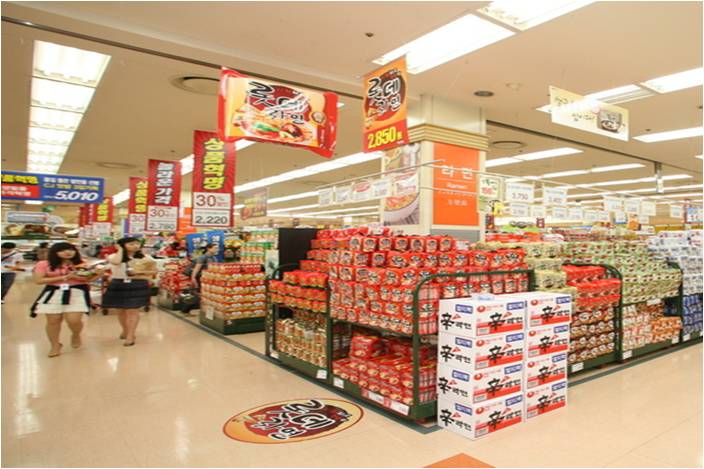
Overhanging shelves full of products, signs informing about promotions and products have a strong presence in supermarkets. In Seoul, most of them are written in Korean but numbers and percentages written using Arabic numerical system can be understood by everyone.
Some basic words such as: open, close, on, off, event, sale, etc. are sometimes used and written in English. I would, however, consider this phenomenon as linked to the fact that some English words are becoming more and more part of the informal language in some countries rather than to the willingness of supermarkets to adapt to foreigners.
The customer service and tax free service desks are usually indicated in English and sometimes in Chinese and Japanese.


Methods of payment:
As in most stores in the World, supermarkets in Seoul accept cash (only Korean Won) and credit cards. Nevertheless, some credit card types such as Visa may not be accepted in every shop.

Of course those supermarkets are part of famous chains that are quite well implemented in Korea. Seoul possesses a few stores and online services whose targets are foreigners. For example, High Street market is a shop located in Itaewon (district of Seoul popular for its high concentration of foreign residents) that offers imported Western goods. Products available are mainly from the US, Canada and the UK as most of their packaging are in English. The staff speaks English and sometimes others languages. The shop owns a website entirely written in English.
In the same thought, the website Fatbag is an Internet superstore for foreigners in Korea. It also sells imported Western products and even IKEA items. The website offers a certain amount of products coming from North American countries, Latin America, Europe, South Africa and Asia; the widest choice of products being those coming from North America. Payment can be made via credit card (Visa, MasterCard, American Express) or Paypal, WireTransfer, etc.
The website is available in English and prices of products can even been shown in dollar (instead of Won).
Those real and online stores are really useful for foreigners that are having trouble getting used to Korean food. Unfortunately, physical stores are spread enough the city for everybody to have one next to home and some people do not feel comfortable shopping online.

As we had noticed through this analysis, supermarkets are making some effort to attract foreigners in their stores thanks to their website, information line and wide opening hours but once in the store foreigners to face Korean signs and products. Indeed for people that can’t read Korean and unfamiliar with Asian products, it takes a little time strolling through shelves recognising and trying to guess what products are.
Of course supermarkets have the same objective than any other business: be profitable. To make money, the number one marketing rule is: identify your customers and adapt your products/services to your target. Supermarkets’ main target being people that live nearby their shop, most of those individuals in the South Korean capital are usually locals; which is why few adaptation to foreigners has been noticed.

References:

Lee, M. J. 1993. Consumer culture reborn: the cultural politics of consumption.

Korea Be Inspired. 2012. Travel highlights.
Retrieved from: http://english.visitkorea.or.kr/enu/SI/SI_EN_3_6.jsp?cid=682553

McCracken, G. 1988. Culture and consumption: new approaches to the symbolic character of consumer goods and activities.

Peñaloza, L. & Gilly, M. C. Journal of Marketing, July 1999. Marketer acculturation: The changer and the changed.


mercredi 26 juin 2013

The Globalization of Seoul's Universities


Only fifty years ago, South Korea was the place where a war took place, but today it becamethe 12th larger economy in the world. The globalization of its economy largely contributed to its actual success and the country is now paying attention to the education of the population who will become the future managers of the country. It is only since 2008 that Korea has been looking at a closer eye to its foreign students and teachers who contribute to the enlightenment to its universities on the worldwide stage. Those universities have been hiring an increasing number of foreign teachers to develop international programs and theyadmitted more than 100,000 foreign students in 2011 (70% of them were Chinese, followed by Japanese students and only 5% of international students) (Kim, 2012).

The issue that arises here is the adaptation problems that foreign teachers and students usually meet when they arrive in Korea. Of course it is a common issue that most universities with foreign students’ faces, but it is also something that needs to be considered seriously. A particular attention to international students has to be given. However in Korea, many international teachers and students decided to return home after a period of non adaptation to the country (Fouser, 2011).This is why more and more universities are now creating special courses and events to help their integration within the university life and to the country’s culture.Most of those problems were easy to solve for the universities as it was mainly housing, food, and social life difficulties. For example, the University of Dongguk in Seoul, organized events for foreign students in order for them to meet more people but also for Korean students to have the opportunity to interact with them. They put in place a service to help students who are facing problems in the country along with the distribution of a booklet to help them integrate the country during their first steps in Korea (Eun-hye, 2011).


Those simple events are essential to be developed by the Korean universities as foreign students contribute to the reputation of a university in term of international programs. However, some universities managed their international students as “cash-cow”. International students fees being higher, a few Korean universities admitted a big number of foreign students without considering if their academic level was suitable to the university courses and without paying attention to their adaptation in the university. This resulted in a very bad reputation and many English teachers wouldn’t work with those institutions as the level being too low, classes were not interesting for both students and professors. This year, South Korea's Ministry of Education, has named 11 institutions that will be banned from admitting foreign students, and another 19 institutions have been ordered to improve policies on their management of international students (Kim, 2012).
Actually, Korean universities are now reaching the criteria for the world universities ranking, as for example the Seoul National University has been on the 37th place this year and 5 others Korean universities are also present on the top 200 universities in the world. It confirms the step that the country is taking towards a more globalized education system, and it reflects the evolution of the Korean economy (Ince, 2013). A better ranking of Korean universities will attract more foreign teachers who can bring value-added to the teaching programs and thus it will attract more international students who bring diversity and an opportunity for Korean students to become internationally aware and ready to become future global manager.


Having studied myself in a Korean university for 3 months, I was able to see that international students’ management is still something new for Korea, and it was difficult to find campus events for international students, mainly because of the language barrier which is big in the country. However, efforts were made from the university staff and we had a constant help from a staff member. We also had the opportunity to discover the culture of the country through some classes and dinner along the program (Photo below: Dinner in a traditional Korean restaurant in Seoul). 


Most of Seoul Universities are integrating international students every year, and they are willing to give the best they can to facilitate their integration through special staff members and welcoming events. However efforts still need to be done for the integration of international students with the Korean students and the language barrier has to be overcame from both sides.

Ophélie Bourgeois

References:

Eun-hye, K. (2011, June 6). Program to help international students adapt to life at Dongguk.Récupéré sur The Dongguk Post: http://www.dgupost.com/news/articleView.html?idxno=1137

Fouser, R. J. (2011, April 11). University globalization and its limits. Récupéré sur The Korea Times: http://www.koreatimes.co.kr/www/news/opinon/2011/04/137_84986.html


Ince, M. (2013, May 22). Korean Universities in the QS World University Rankings by Subject 2013. Retrieved from: Top Universities: http://www.topuniversities.com/where-to-study/asia/korea-south/korean-universities-qs-world-university-rankings-subject-2013

Kim, H.-S. (2012, January 4). SOUTH KOREA: Foreign student ban on 11 institutions. Récupéré sur University World News: http://www.universityworldnews.com/article.php?story=20120104133043997


dimanche 9 juin 2013

About the theme of this blog...


A lot of studies have been published on how immigrants adapt to a different culture and country. We’ve heard about the “segregation, integration, assimilation” concept, where segregation is the rejection of the local culture, integration is a mix between the local and native culture and assimilation is the adoption by the immigrant of local consumption habits, traditions and way of life.
This existing literature demonstrated several theories and conclusions about how people adapt to foreign cultures and countries. In this blog we would like to do research on the inverse topic: how worldwide cities adapt to foreigners? Instead of studying how a person adapts to a new environment we will focus on how an environment can adapt to people that are not used to it?
According to the NCSL’s (National Conference of States Legislatures) top 10 policy issue forecast published in 2008, integrate people with different cultures and backgrounds in a nation’s society represents a major concerns for Western countries.
Being exposed to a new environment (“unfamiliar economic, biological, physical, social and cultural conditions”) can cause tension or anxiety to some people (Luedicke, M.K. 2011). And even though tourists travel to discover new things and being confront to uncertainty; we think that expatriates, immigrants and/or exchange students won’t mind a little local help in their assimilation process.

References:

Luedicke, M. K. 2011, July 22nd. Consumer acculturation theory: (crossing) conceptual boundaries.

NCSL. 2008. NCSL’s top 10 policy issue forecast: Heat is on state legislatures.

Public Transportation in Seoul


To further analyze Seoul’s cultural adaption to foreigners, we are now going to look at the city public transportation.
The most three used ways to move in Seoul are to take the subway, the bus or a taxi, that’s why we will only focus on those transportation modes in this article.
According to “About.com Geography”, Seoul’s subway is the third busiest metro in the World (after Tokyo’s and Moscow’s). Indeed, it completes an average of 2.04 billion annual passenger rides and receives 5.6 million daily riders (Schulz Richard, K., 2011). 
Language used in the subway facilities is Korean, English, Chinese and Japanese. All vending machines operate in those four languages.
Subway maps are also available in four different languages. Find below snapshots of Seoul subway map in English and in Korean.


Within the subway train, stations are announced in Korean, English and Chinese. Fortunately, in each station, the name of the station is written in Korean signs and using Roman alphabet because pronunciation can sometimes differ from what we read.


As you can see on the picture, each station is numbered as well as exits, which makes things easier for tourists and foreigners that are having trouble with Korean pronunciation.
Pictograms are also used to indicate toilets, elevator... so it can be understood from everyone.

Below is an example of signs present in subway stations. The first sign indicate the way out with the number of the exit and the second sign indicate the way to go to transfer to line 7 in Korean, English and Chinese.


Just by taking the subway in Seoul, you can have an insight of the Korean culture: how technology is present in everyone’s life, respect of the elderly, etc.
To learn more about it, please go watch the video hosted on the Official Site of Korea Tourism Organization page: http://www.visitkorea.or.kr/ena/TR/TR_EN_5_1_4.jsp (Korea Be Inspired, 2012).

Regarding buses in Seoul, four categories exist. Each category is designated by a color code: blue, yellow, red and green, according the type of road they use, the length of their travel, their circuit and the destination. Each bus is identified by a color and a number, which are universal elements of codification understood by everyone (given the fact that people are aware of what the color code means).
Unlike the subway, taking the bus can be confusing for strangers because of the large extent of the network. Indeed, according the website Korea4expats.com, there are approximately 400 bus circuits with 8,500 city buses.
Bus stops are easily recognizable, as you can see on the picture, they are grey with a bus pictogram at the top in the color of the category of the bus that is stopping at this station.
Circuits put up on bus stops are written in Korean, only few stops are written English (maybe 3 or 4 per circuits). That is why, without any previous preparation using the Internet (http://topis.seoul.go.kr/eng/) to look for which bus to take and where to stop, foreigners can not really make it.


QR codes can be found on most of bus stop in Seoul. Those QR codes can really be useful for tourists as they give information about the bus network in Korean, English, Chinese and Japanese. Moreover a helpline is available.

Taxis can be found really easily in Seoul’s streets. Even though an increase number of taxi drivers speak English, it is still advice to write, in Korean, on a piece of paper the name of the destination you want to go to. Indeed, foreigners’ Korean pronunciation is not well understood by local taxi drivers. In the middle of 2009, “International taxi” service has been created where taxi drivers can speak English or Japanese. Moreover those kinds of taxis can be paid with international credit cards: VISA, MASTER, AMEX, JCB (Korea Be Inspired, 2012). Reservations for international taxis can be made by English or Japanese speakers by calling an exclusive call center or on this website: www.intltaxi.co.kr.

The real strong point of Seoul’s public transportation is its unique method of payment whereas you are taking the subway, the bus or even a taxi. This method of payment is in the form of an electronic card, called the “T-money card”. It can be reloaded in department stores or thanks to vending machines present in each subway stations. To use the T-money card, a simple beep on card readers is needed. Taxi, buses and subway’s security gates are all equipped with card readers which make payments really easy to make.
For buses and subways a beep going in and another going out of the transportation facility is needed. Thanks to that system, final destination does not have to be known or specify by the user, the card itself withdraw the correct amount of money that is due.
This unique method of payment for public transportation is really useful for foreigners that can still not recognize the Korean different coins. It is easy, quick and practicable!

To conclude this article on public transportation, we can see that a real effort is done to make them accessible to tourist and foreigners. As we previously saw with food facilities and touristic spots, most signs are translated into English, Japanese and Chinese.


References

Korea 4 expats.com. 2011. By bus in Seoul.
Retrieved from: http://www.korea4expats.com/article-seoul-by-bus.html 

Korea Be Inspired. 2012, April. Public Transportation.
Retrieved from: http://english.visitkorea.or.kr/enu/TR/TR_EN_5_1_1.jsp 

Schulz Richard, K. 2011, July 26th. The World's Busiest Subway Systems in Major Cities.
Retrieved from: http://geography.about.com/od/urbaneconomicgeography/a/Busiest-Subways.htm

samedi 1 juin 2013

Restaurants' adaptation to foreigners in Seoul


To start our research about the South Korea capital’s establishments and organizations and see how and in what way they adapt to foreign cultures, we decided to begin with an analysis of restaurants’ cultural adaptation.
Through this article, we are going to analyse how food facilities in Seoul are adapted to foreign cultures by looking at the layout and content of their menu. We won’t focus on the actual meals that are offered but on the way they are communicated to clients.
After investigating and experiencing several food facilities during our journey in Seoul, we decided to separate restaurants into four categories:
           - Worldwide known fast-food chain
           - Medium-standing Korean restaurant
           - Small Korean food facility
           - Street food stand


Not surprisingly, we noticed that worldwide known fast-food chains such as Mc Donald, KFC, Burger King... are the food facilities that adapt the most to foreign cultures. Indeed, looking at their menu we can see that the name of each set is written in Korean, English, Japanese and Chinese. A photo is displayed for each dish and prices are also written using Arabic numbers. You have to know that Korean language uses two different set of cardinal numbers: Korean native numbers and Sino-Korean numbers. Most of the time Arabic numbers are used to indicate prices but sometimes prices are written using Sino-Korean numbers (based on Chinese numbers).


About medium-standing Korean restaurants’ menu, as you can see on the picture below, photos are usually available. The Korean name of the meal is most of the time translated into English but not the description of it. The name of the dish can also sometimes be translated in Chinese.
In those cases it is up to us to give free rein to our imagination and guess which ingredients constitute the meal exactly.

If you want to feel what it is like to order a meal just relying on a picture, go visit School Food’s website (a quite famous Korean restaurant chain) and see for yourself: http://www.schoolfood.co.kr/menu

Regarding small Korean food facilities, no actual paper menu are available inside the restaurants, names and prices of meals offered are displayed on the walls and windows. No other language than Korean is used to describe the dishes offered in this kind of restaurant. To order a satisfying meal in those food facilities, luck will have to play a major role!


Street food stands do not offer menu, food available is displayed in front of customers. To place an order and know the price of what is bought, body language is required as the stand holder usually do not speak English.


The English speaking level of waiters and waitresses in food facilities in Seoul are diverse. Most of them have knowledge about the English language but advanced communication remains difficult.

Overall, restaurants in Seoul tend to translate minimum information into English, so it can be understand by most foreigners (assuming they speak English). Japanese and Chinese translations are also sometimes available. The choice of these three languages makes sense knowing that they are Korea’s top three international tourism markets. The graph below shows us that tourists from those three countries represent a high percentage of overall tourism revenues for South Korea (Visa, 2012): 
Visa. 2012, May. Tourism Outlook: South Korea.

If you ever went to South Korea or experienced similar situations in restaurants in a foreign country please leave comments, we would like to know your opinion. Do not hesitate to leave your impressions about this article as well!

References:

Visa. 2012, May. Tourism Outlook: South Korea.